
Your Passport Is Not a Credit Card: The End of Sangla- Passport Under RA 11983
If you grew up in the Philippines, you have probably heard of sangla-passport — the practice of handing your passport to an informal lender as "collateral" for a small loan. It was so common that people treated it as normal. Tiyahin mo sa palengke, kapitbahay, kahit kaibigan — it happened everywhere.
It was never legal. But for decades, there was no specific law with teeth heavy enough to stop it. The DFA always said the passport belongs to the government. The problem was that telling a bombaylender "this is government property" didn't exactly make him hand it back.
That changed in March 2024. Republic Act No. 11983 — the New Philippine Passport Act — finally gave this crime a name, a clear definition, and a penalty serious enough that no rational person would risk it: up to 20 years in prison and a ₱2 million fine.
This post covers everything you need to know: what the law actually says (I read the full text so you don't have to), what's been exaggerated online, and exactly what to do if someone is holding your passport right now.
First: Why Was This Even Legal Before?
It wasn't legal. It was just unaddressed.
The old Philippine Passport Act of 1996 (RA 8239) said the passport belongs to the government and cannot be confiscated by anyone except the DFA. But the penalties were vague. There was no specific provision that said "if a private person keeps your passport, here is exactly how many years they go to jail." That legal gap is what informal lenders and some unscrupulous employers exploited for decades.
RA 11983 closed that gap completely. It does two things in one law:
Section 13 reaffirms that your passport is government property at all times and cannot be held by anyone other than the DFA.
Section 22(a) attaches a criminal penalty so specific and so heavy that there is now zero ambiguity about the consequences.
DIRECT FROM THE LAW — RA 11983, SECTION 22(A)
"Any person or entity without legal authority who confiscates, retains, or withholds any passport issued by the DFA shall suffer the penalty of imprisonment of not less than twelve (12) years and one (1) day but not more than twenty (20) years, and shall pay a fine of not less than One million pesos (₱1,000,000.00) but not more than Two million pesos (₱2,000,000.00)."
Those are not slap-on-the-wrist fines. That is the same range of imprisonment as many serious violent crimes. The government made a deliberate choice to equate passport withholding with a major offense against the State — because it is.
The Key Legal Logic: "You Cannot Pawn What You Don't Own"
Here is the thing that trips people up: many victims of sangla-passport voluntarily handed over their passport. Does that mean the lender isn't committing a crime if they kept it?
No. Because you cannot legally transfer ownership of something you don't own. The passport belongs to the Republic of the Philippines — not to you. Your name is on it, but it is a government document issued on your behalf. That means you have no legal authority to pawn it, sell it, or use it as collateral. And the person who accepts it as collateral has no legal authority to keep it.
The law doesn't care whether the exchange was willing. Keeping the passport is the crime. The moment a lender or employer retains your passport without DFA authorization, they are committing an offense under Section 22(a) — every single day they hold it.
⚠️ IMPORTANT: YOU CAN ALSO BE LIABLE
This part is often left out of online discussions. Under Section 22(c)(3) of RA 11983, the holder who pawns or uses their passport as collateral also commits a crime — punishable by 6 years and 1 day to 15 years and a fine of ₱100,000 to ₱250,000.
Both parties face criminal charges. The lender faces the heavier penalty under Section 22(a). The borrower faces a separate charge under Section 22(c). Do not pawn your passport — period.
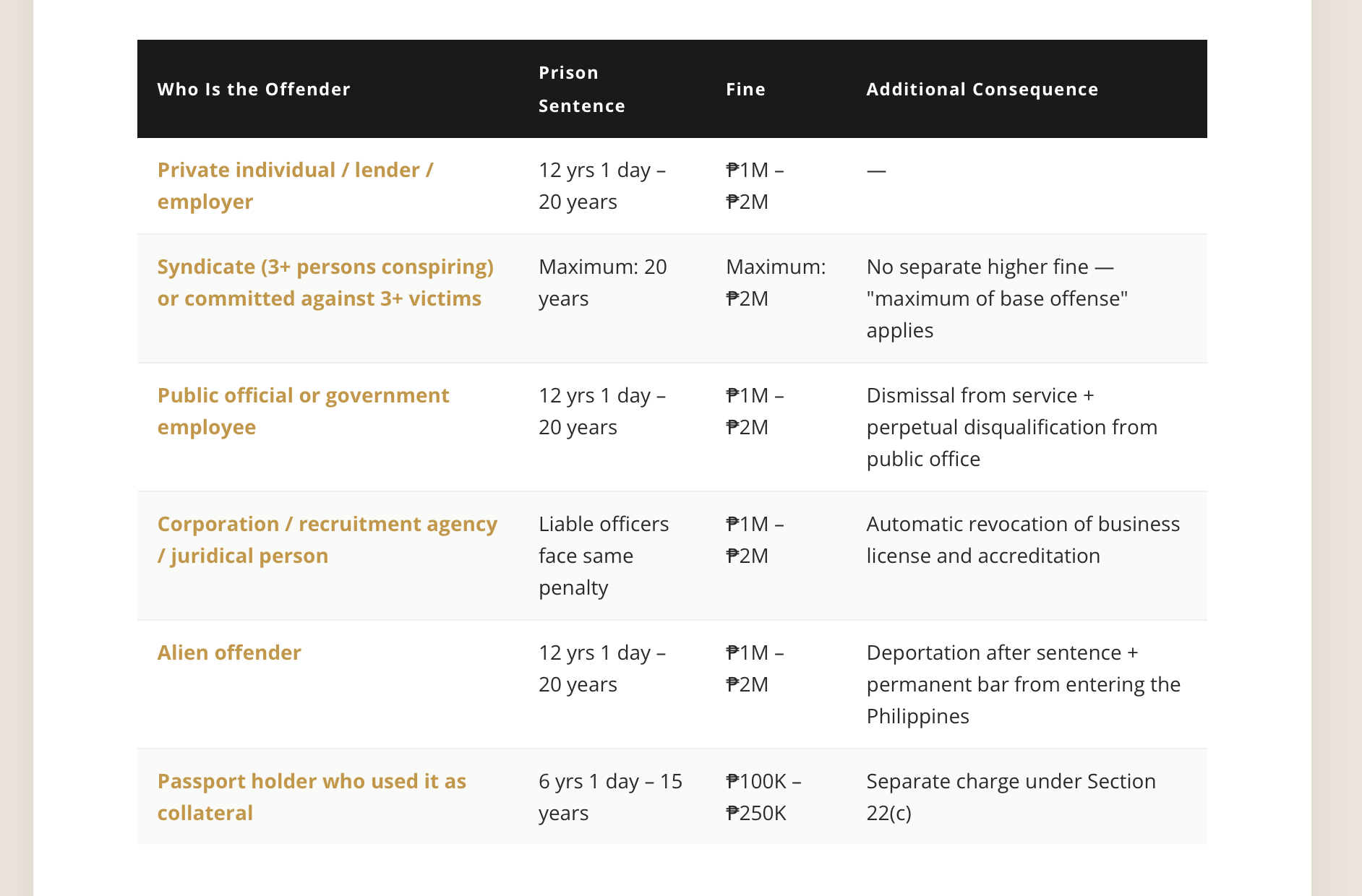
The Full Penalty Table (Corrected)
Some versions of this topic floating around online include incorrect figures — including a claimed ₱5 million fine for syndicated cases that does not exist in the law. Here is the accurate table based on the full text of RA 11983:
What About OFWs? Can a Foreign Employer Be Held Liable?
This is the question I get most from ka-lakwatseras working abroad — especially those in the Middle East and Hong Kong, where passport confiscation by employers has been a well-documented problem for decades.
The honest answer is: RA 11983 itself does not have an extraterritoriality clause. It does not explicitly say "this law reaches across borders." What it does say in Section 22(a) is that prosecution under RA 11983 is "without prejudice to any liability for violation of Republic Act No. 8042" — the Migrant Workers and Overseas Filipinos Act.
RA 8042 is the law that actually has teeth for OFW cases. It holds Philippine recruitment agencies liable for the actions of their foreign principals. So the practical route for OFWs is this:
The foreign employer may be beyond direct Philippine jurisdiction — but they face being reported to local authorities in their country and blacklisted by DMW and DFA.
The Philippine recruitment agency that deployed you can be held liable under RA 8042 for what their foreign partner did — including passport confiscation. RA 11983 charges can be filed simultaneously.
The DMW in 2026 uses RA 11983 reports to immediately investigate and pull the license of any Philippine agency reported for passport retention cases.
FOR OFWS: YOUR FIRST CALL IS DMW
If your employer abroad is holding your passport, do not wait. Contact the DMW through their 24/7 hotline or the Migrant Workers Office (MWO) / Philippine Embassy in your country. They have established protocols for passport recovery in foreign postings.
How to Recover Your Passport: Step-by-Step
STEP 1 — SEND THE DEMAND
Before filing a formal complaint, most lawyers recommend sending a formal demand via SMS, Viber, or email — something you can screenshot and use as evidence. Keep it simple and factual:
📋 SAMPLE DEMAND MESSAGE (COPY AND SEND)
I am formally demanding the immediate return of my Philippine Passport. Under Republic Act No. 11983 (New Philippine Passport Act, 2024), any person who confiscates, retains, or withholds a Philippine passport without legal authority faces imprisonment of 12 to 20 years and a fine of up to ₱2 million. If I do not receive my passport by [Date / Time], I will file a criminal complaint with the NBI and report this to the DFA for passport cancellation.
Most informal lenders will return the passport immediately. They are not running a sophisticated criminal enterprise — they are trying to collect a debt. The moment they realize they are personally facing two decades in prison, the calculation changes fast.
STEP 2 — FILE A CRIMINAL COMPLAINT
If the demand is ignored, file a formal complaint at the nearest NBI office or PNP station. You do not need a lawyer to do this — go in person, bring any evidence (screenshots, the demand message you sent, loan documents if any), and ask to file a complaint under RA 11983.
STEP 3 — CANCEL THE PASSPORT AT DFA
If you cannot get the passport back physically, go to the DFA and file an Affidavit of Loss / Mutilation, specifically stating that the passport was illegally withheld. Under RA 11983, the DFA can then cancel the passport in its global database — making it completely useless to whoever is holding it. They cannot use it, sell it, or do anything with a cancelled document. This removes their only leverage.
DFA CONTACT FOR PASSPORT CANCELLATION
DFA Office of Consular Affairs (ASEANA): (02) 8651-9400
Email: oca.concerns@dfa.gov.ph or passportconcerns@dfa.gov.ph
Who to Contact, Depending on Your Situation
🛫 OFWS — EMPLOYER HOLDING YOUR PASSPORT ABROAD
📞DMW 24/7 Hotline: 1348 (inside the Philippines) | +63-2-1348 (international)
📧Email:connect@dmw.gov.ph (general) | repat@dmw.gov.ph (repatriation / urgent assistance)
🏢Abroad: Report to the Migrant Workers Office (MWO) or Philippine Embassy in your country
🏦 INFORMAL LENDER / SANGLA-PASSPORT INSIDE THE PHILIPPINES
📞NBI Main Trunkline: (02) 8523-8231 to 38 — ask to file a complaint under RA 11983
📧NBI Complaints Email:crd@nbi.gov.ph
🏢Address: NBI Building, Taft Avenue, Ermita, Manila 1000
🚨PNP Emergency: 911 — if you are in immediate danger or being physically restrained
⚖️ TRAFFICKING OR COERCION (PASSPORT USED TO CONTROL YOU)
📞IACAT Action Line Against Human Trafficking: 1343
📧DOJ Action Center:dojac@doj.gov.ph
🌐Website:iacat.gov.ph
📘 CANCEL THE PASSPORT AT DFA
📞DFA OCA: (02) 8651-9400
📧Email:oca.concerns@dfa.gov.ph | passportconcerns@dfa.gov.ph
📝File an Affidavit of Loss/Mutilation stating the passport was illegally withheld. DFA may waive related fees for victims.
The Bigger Picture
Sangla-passport wasn't just a quirky local practice. It was a debt trap built specifically for people who had no other collateral — no land title, no savings account, no car. For many poor and working-class Filipinos, their passport was the only document that represented a future: a way out, a work permit, a chance to send money home.
Lenders knew exactly what they were doing. They were not holding a piece of paper. They were holding someone's mobility hostage.
By making this offense punishable by up to 20 years in prison, the government sent a message that your right to travel is a constitutional right — not a bargaining chip. Article III, Section 6 of the Philippine Constitution protects the right to travel. RA 11983 is how that protection gets enforced at ground level.
If you are reading this and someone is currently holding your passport — whether it is a lender in your barangay or an employer in Riyadh — you are not powerless. Send the demand message above. File the complaint. Cancel the document. The law is on your side now, and it has serious teeth.
BOTTOM LINE
Your passport is not yours to pawn, and it is not theirs to keep. Under RA 11983, anyone holding your passport without DFA authorization is committing a crime worth 12 to 20 years in prison. If you are a victim: demand it back, report it to the NBI or DMW, and cancel it at the DFA. The document becomes worthless to them the moment DFA cancels it in the system.
