
To become a digital nomad as a Filipino, start by developing a skill you can deliver online, finding paying work, and building a budget that covers both living and working costs. Test your setup close to home before travelling farther. For overseas trips, check the destination's entry and remote-work rules, along with your employer's or client's requirements.
You do not need to visit another country to begin preparing. Your first step can happen at your kitchen table in Laguna, in a rented room in Cebu, or after your shift abroad.
I know how distant this life can feel.
I grew up in San Pablo City, Laguna, helping my Lola at her sari-sari store and learning how to make limited resources stretch. Later, I studied economics at the University of the Philippines Los Baños and became an Overseas Filipino Worker in the Middle East.
Travel was something I dreamed about long before I knew how I could afford it.
In January 2025, I completed my journey to all 195 countries using my Philippine passport. Filipino World Travelers records my completion of all UN member countries on January 6, 2025, and recognizes me as the first Filipino to achieve that milestone using solely a Philippine passport. The Philippine Senate's Resolution No. 243 also commended my achievement as the youngest Filipina to travel to all 195 countries using a Philippine passport.
But the part that matters for your own beginning is what happened before those recognitions: learning new skills, finding work, making mistakes, and figuring out how to keep going.
That is the journey behind my book, Career or Travel, Why Not Both? How to Become a Digital Nomad. Here is how I would help a Filipino beginner turn that possibility into a practical plan.
What is a digital nomad?
A digital nomad earns through work that can be done remotely and uses that flexibility to spend time living or travelling in different places.
The work might involve employment, freelancing, or running an online business. The “nomad” part describes how you live and travel; it is not a job title.
A virtual assistant who works permanently from home is a remote worker. If that person has the necessary permissions and arrangements to keep working while spending time in different destinations, they may also live as a digital nomad.
You can start within the Philippines. International travel can come later, when your work, finances and documents support it.
1. Decide what you want your working life to look like
Before choosing a destination, ask yourself what you want to change.
Do you want to visit your family more often? Spend a month somewhere new? Build an international career while keeping your home in the Philippines? Travel between projects?
Those are different goals, and they need different arrangements.
In 2013, I was working in Kurdistan, Iraq. I had a secure job, a salary and responsibilities back home. From the outside, I was following a familiar version of the Filipino dream. Inside, I kept wondering whether that was the only life available to me.
I eventually left and began backpacking in Southeast Asia. That was my decision, shaped by my circumstances. Your plan should account for yours.
Write down three things:
What you want more of: travel, flexibility, income opportunities or time with family.
What you must protect: household support, debt payments, health needs or job stability.
What you can test now without making a major commitment.
If you are a breadwinner, a gradual transition may give you more room to learn while protecting the people who rely on you.
2. Choose one skill you can offer online
Start with something specific enough that a client can understand what you will deliver.
“I can help with anything” is difficult to evaluate. “I can turn your recorded interviews into short captioned videos” gives someone a clearer reason to hire you.
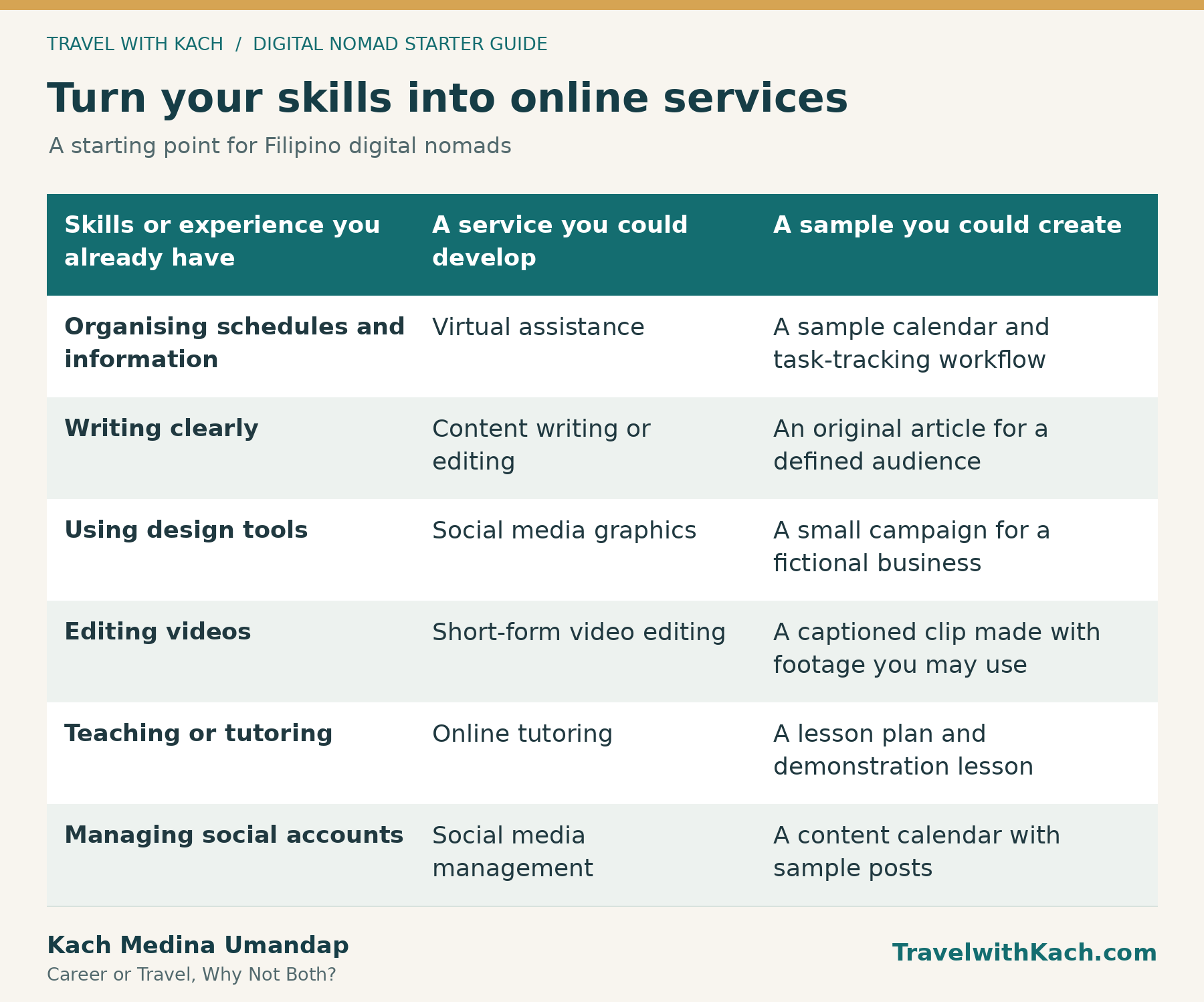
These are possible starting points, not promises of employment. Requirements vary by client, employer and teaching platform.
My own income developed through different kinds of work. I taught English, wrote travel stories and worked on social media. In Ollantaytambo, Peru, I wrote stories for online publications, including Rappler. Each assignment helped me see how a skill could support another part of my journey.
Choose one service to practise first. You can expand after you understand what clients need and what you can deliver well.
3. Build a small, honest portfolio
You need a way to show your work, even before you have a long client list.
Create two or three examples that match the service you want to offer. Explain the problem, the intended audience and your approach.
For a social media portfolio, you might develop a sample campaign for a fictional guesthouse. Include the proposed audience, several posts and an explanation of what each post is meant to achieve.
Label it clearly as a sample project. Do not invent a client, testimonial or performance result.
In my book, I share the story of someone who worked with me while she was still studying. When she graduated, we gathered the projects she had completed into a portfolio. She could show potential employers what she had actually done.
Your first portfolio can be simple. What matters is whether it demonstrates useful work and makes your role clear.
4. Look for work that fits your location plans
Before accepting a role, find out what “remote” means to that employer or client.
Ask about:
Required working hours and time zones.
Countries or locations from which you may work.
Equipment, internet and data-security requirements.
Meetings, response times and expected deliverables.
How payment and changes to the scope will be handled.
A home-based position may still require you to remain in a particular country. Establish the arrangement before making travel plans.
When approaching a potential client, keep your message specific. For example:
“I noticed your hotel has useful guest reviews but very few recent social posts. I created a short sample content plan showing how those reviews could become helpful posts for future guests. Would you be open to discussing support with your content?”
That is an illustrative pitch, not a message I am claiming to have used.
Track your applications and conversations. You will learn more from a manageable number of thoughtful pitches than from sending the same generic message everywhere.
5. Build a budget around your actual responsibilities
There is no single starting budget that works for every Filipino digital nomad.
Someone who already owns a suitable laptop and can work from a family home has different costs from someone supporting dependants and paying for overseas accommodation.
List your costs before deciding how far you can travel:
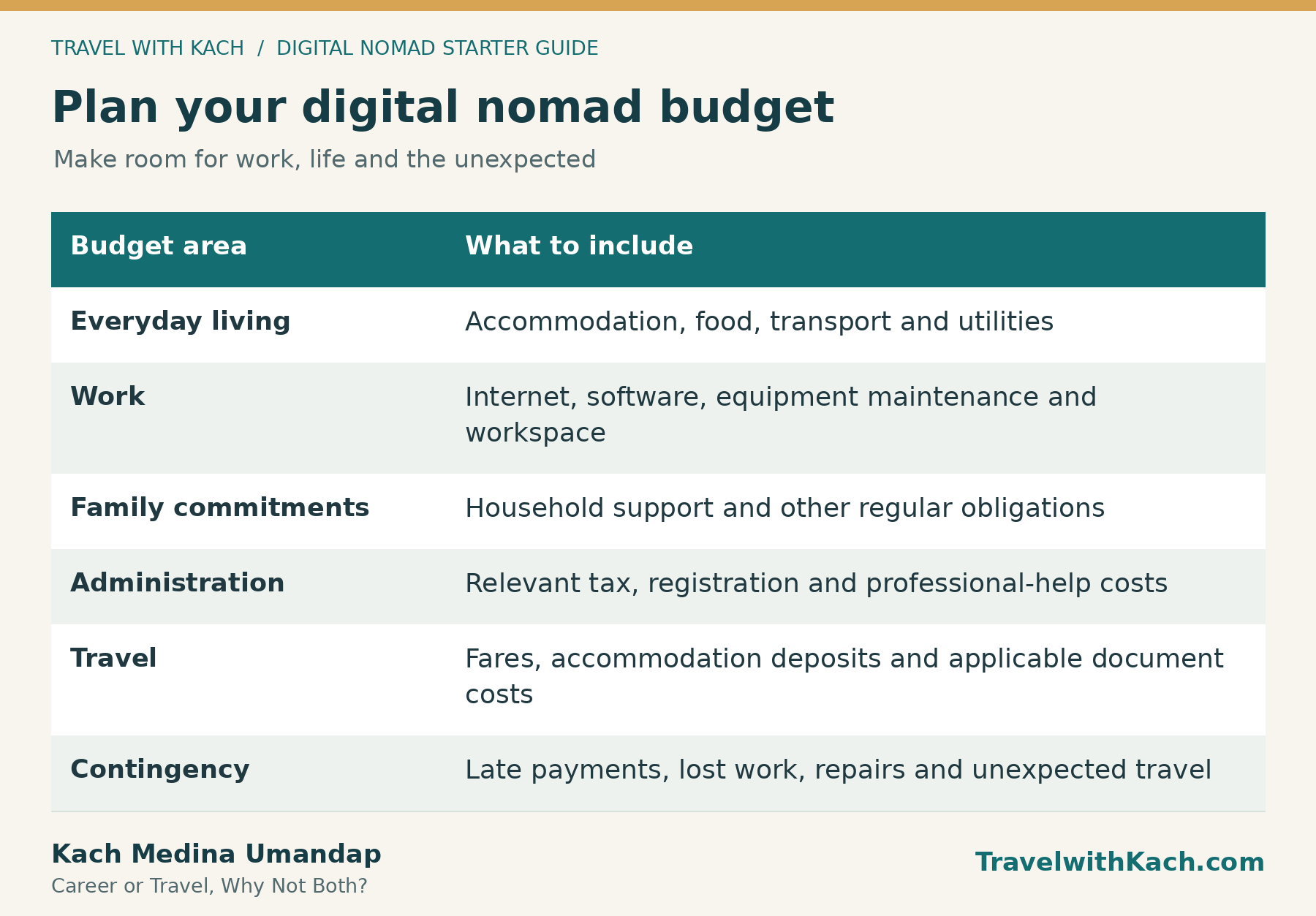
Separate confirmed income from income you hope to earn. A promising conversation is not a paid invoice.
A useful planning calculation is:
Available buffer ÷ essential monthly expenses = approximate months of cover.
For illustration, a ₱90,000 buffer divided by ₱30,000 of essential monthly expenses equals three months. That does not include additional travel costs or unexpected bills. It is a calculation example, not a recommended amount for everyone.
My lesson from travelling is that flexibility becomes much harder to enjoy when every delay or equipment problem threatens your ability to work.
6. Set up the practical side of working online
Before adding travel, practise completing a project from start to finish.
Can you agree on the work, deliver it, handle revisions, issue the appropriate billing documents and receive payment?
I remember working on social media for a boutique hotel in Manuel Antonio, Costa Rica. The setting was beautiful, but I was still learning basic business tasks, including how to send an invoice.
A lovely destination does not remove the need to understand your work.
Prepare:
A written agreement on scope, deadlines, revisions and payment.
A payment method available to you, with fees checked.
A system for keeping contracts, receipts and income records.
Secure accounts, backups and a plan if your device fails.
For Philippine registration and tax questions, start with the Bureau of Internal Revenue and seek advice appropriate to your work arrangement. Working internationally can introduce additional questions; an overseas client or a travel lifestyle does not by itself settle your tax position.
7. Test your routine close to home
Try a short stay somewhere you can reach without putting your work or budget under unnecessary pressure.
Treat it as a normal working week. Keep your deadlines, attend meetings and track your spending.
Before booking, ask the property about the actual workspace and connection. Check whether mobile data works as a backup and what happens during a power interruption.
A good test will tell you:
Whether you can work comfortably for several hours.
Whether the connection supports the tasks you do.
Whether noise, heat or transport affects your schedule.
How much time and money you really spend.
Whether you still have energy to enjoy the destination.
In South America, I experienced the difficult side of moving too often: deadlines building up while I struggled with unreliable Wi-Fi and the demands of another new place.
That experience changed how I thought about pace. Give yourself time to settle into a location and complete your work.
8. Check the rules before working from another country
For international travel, investigate these separately: permission to enter, permission to carry out your planned activities, and your employer's or client's permission to work from that location.
Use the destination's official immigration or consular guidance for your nationality and circumstances. Ask the relevant authority when the rules do not clearly address your situation.
Before paying for a longer stay, check the applicable documents, permitted activities, length of stay, insurance requirements and possible tax implications.
My digital nomad visa guide for Filipinos is a starting point for exploring options. Always confirm the current requirements with the responsible government authority before applying.
Your Philippine passport is part of your planning. Build time for research and paperwork into your itinerary.
Your first 30 days: a realistic starting plan
You do not need to solve your entire future this month. Aim to finish with clearer evidence about your skills, costs and opportunities.
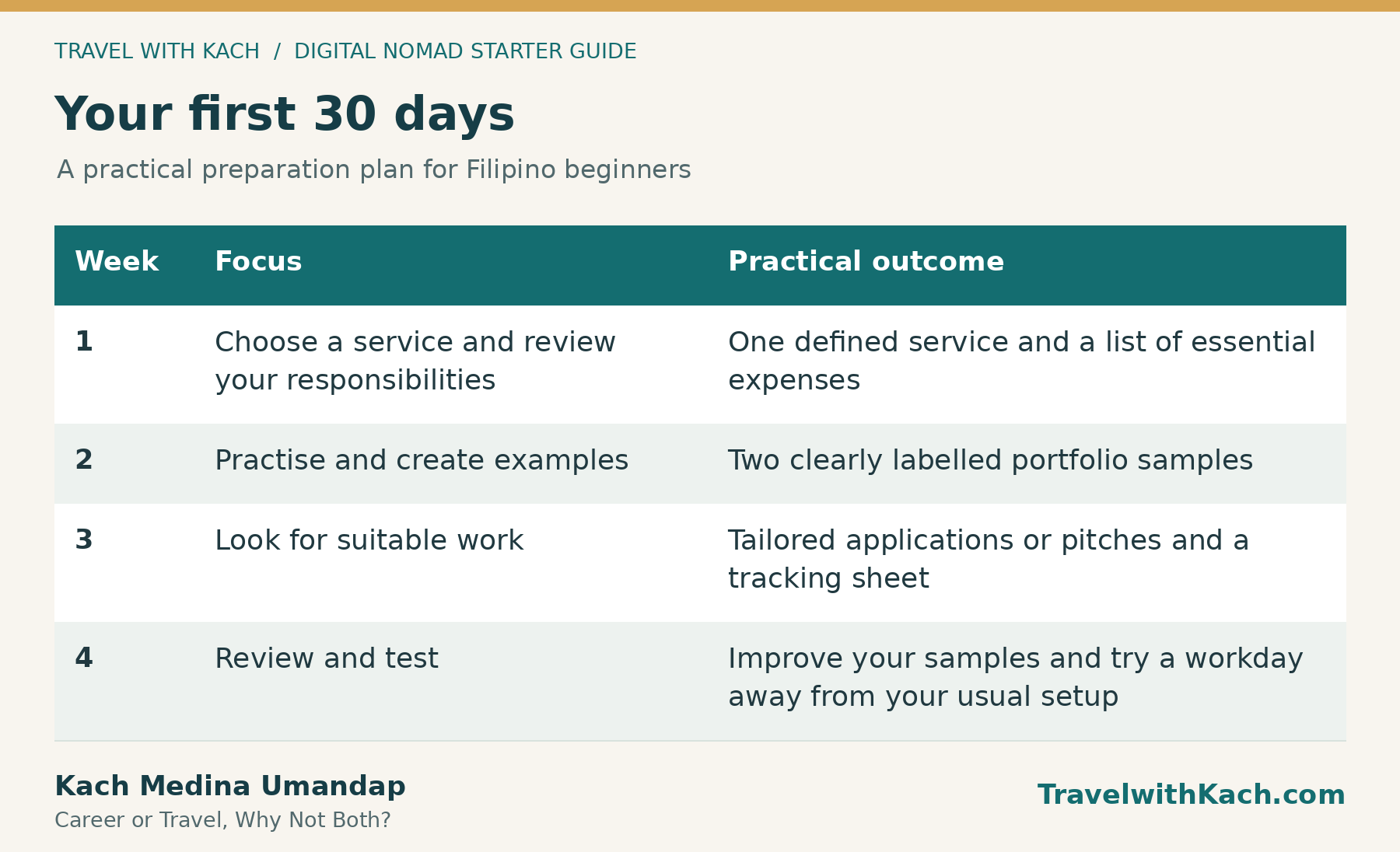
This is a preparation plan, not a promise that you will have a client or be ready to travel in 30 days.
If you discover a skill gap, you have something concrete to work on. If a trial workday goes badly, you can adjust before committing to a longer trip.
Frequently asked questions
Can I become a digital nomad without experience?
You can start preparing without paid experience. Develop a useful skill, create honest sample projects and practise delivering work. Getting paid depends on finding an employer or client whose requirements you can meet.
Do I need a degree to become a digital nomad?
There is no single qualification called “digital nomad.” Requirements depend on the job, client, profession and any immigration route you use. Some opportunities require degrees or certifications; others place more emphasis on demonstrated skills.
Do I have to leave the Philippines?
No. You can work towards a portable career from home and try travelling within the Philippines. International travel is an option to plan for, not a requirement for getting started.
Should I resign before finding online work?
Consider testing your skills and securing suitable work while you still have income, where your employment terms allow it. Your decision should reflect your obligations, savings and tolerance for uncertainty.
How long does it take to become a digital nomad?
There is no reliable universal timeline. Your starting skills, available time, finances and work opportunities all matter. Use milestones—portfolio completed, work secured, budget tested—instead of judging yourself against someone else's travel photos.
Start with the life you have
When I was growing up in Laguna, I did not have a complete plan for visiting the world. Later, when I began earning while travelling, I was still learning through each assignment and unfamiliar situation.
Your first milestone might be completing a portfolio, earning from a skill you have practised, or taking a short trip without missing a deadline.
Those steps count.
I wrote Career or Travel, Why Not Both? How to Become a Digital Nomad, published by Penguin Random House SEA, to share the personal lessons and practical thinking behind my journey—from the mindset shift to building a portable career and choosing how to live.
If you want a companion for planning your own next steps, get your copy of Career or Travel, Why Not Both? on Shopee.
About the author: Kach Medina Umandap is a Filipina traveller, digital nomad and author raised in San Pablo City, Laguna. Her journey to all 195 countries using a Philippine passport was recognized by the Philippine Senate. She shares practical guidance on travel and portable careers through TravelwithKach.com. Read more about Kach.
Personal experiences in this article are drawn from Career or Travel, Why Not Both? How to Become a Digital Nomad. Travel rules and individual work arrangements should be checked before making plans.
