
By Kach Umandap - Youngest Filipina to visit all 195 countries, and the First Filipino to do it solely on a Philippine passport
Last updated: September 2026
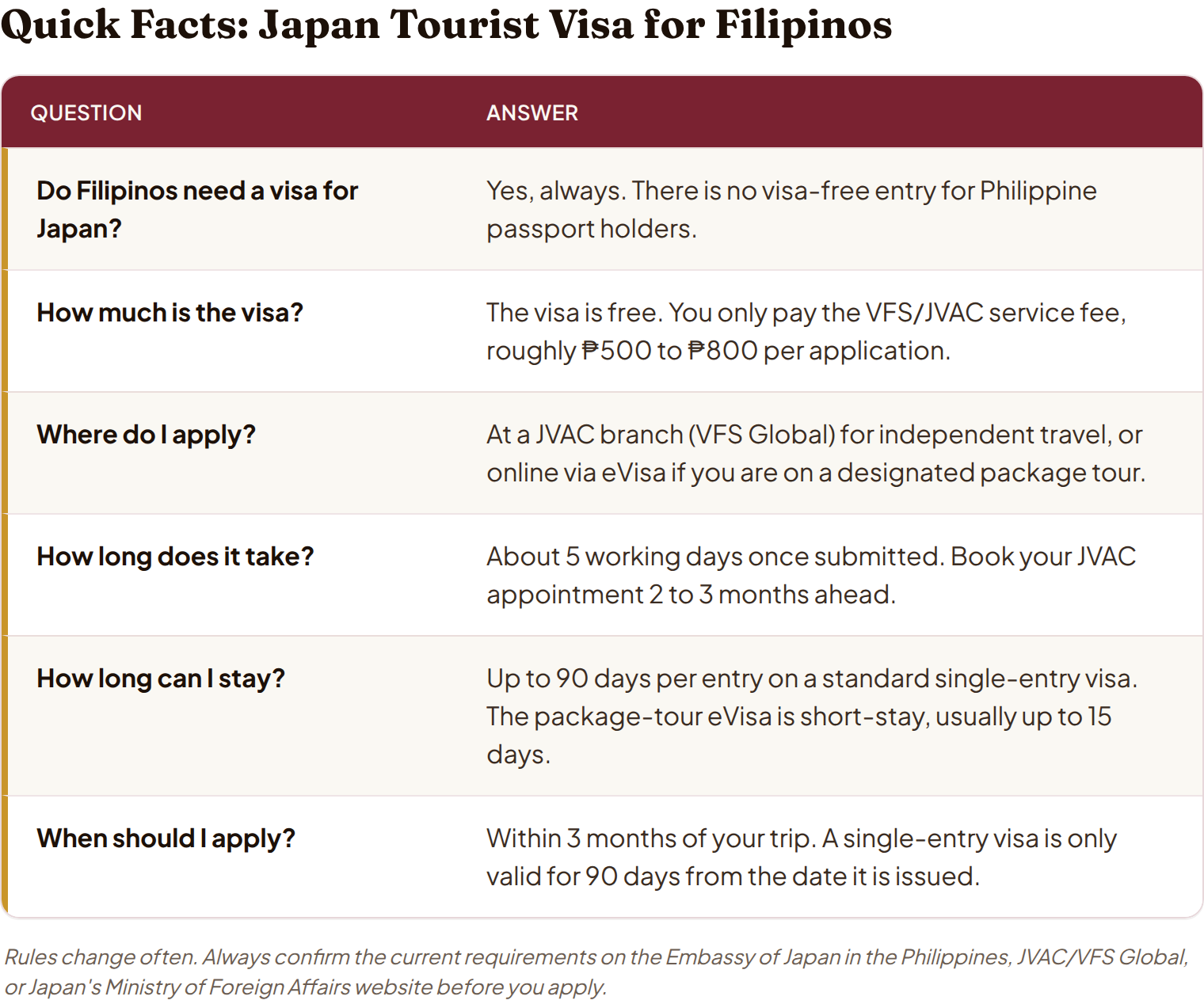
Quick answer: Yes, Filipinos need a tourist visa to enter Japan. The good part is that the visa itself is free, and your maroon passport qualifies through two routes: the standard JVAC (VFS Global) application for independent travelers, and a newer online eVisa for Filipinos joining a Japan-registered package tour. Most first-timers get approved when their documents are complete and their finances are clear. Below is the full walkthrough, start to finish.
Do Filipinos Need a Visa to Visit Japan?
Yes. Japan does not offer visa-free entry to Philippine passport holders. Every Filipino tourist needs a visa issued before departure. You cannot get one on arrival.
I want to frame this the right way, because a lot of articles talk about the Philippine passport like it is a problem to apologize for. It is not. Our maroon passport keeps climbing, and Japan is one of the clearest examples of that progress. A few years ago, every applicant had to file through an accredited agency and hand over a thick stack of paper. Now there is an online route for many travelers, and approval rates for prepared Filipinos are strong. Japan is a mid-level step, and once you clear it, it becomes proof for the bigger visas later.
That is the whole idea behind my Philippine Passport Cascade Hack™: Southeast Asia first, then the rest of ASEAN, then Japan and Korea, then Schengen and the UK, then the US and Canada. Japan sits right in the middle. Every stamp you collect here builds the travel history that makes Schengen, the UK, and the US far easier to get. So getting your Japan visa is not just about one trip. It is you moving up a rung.
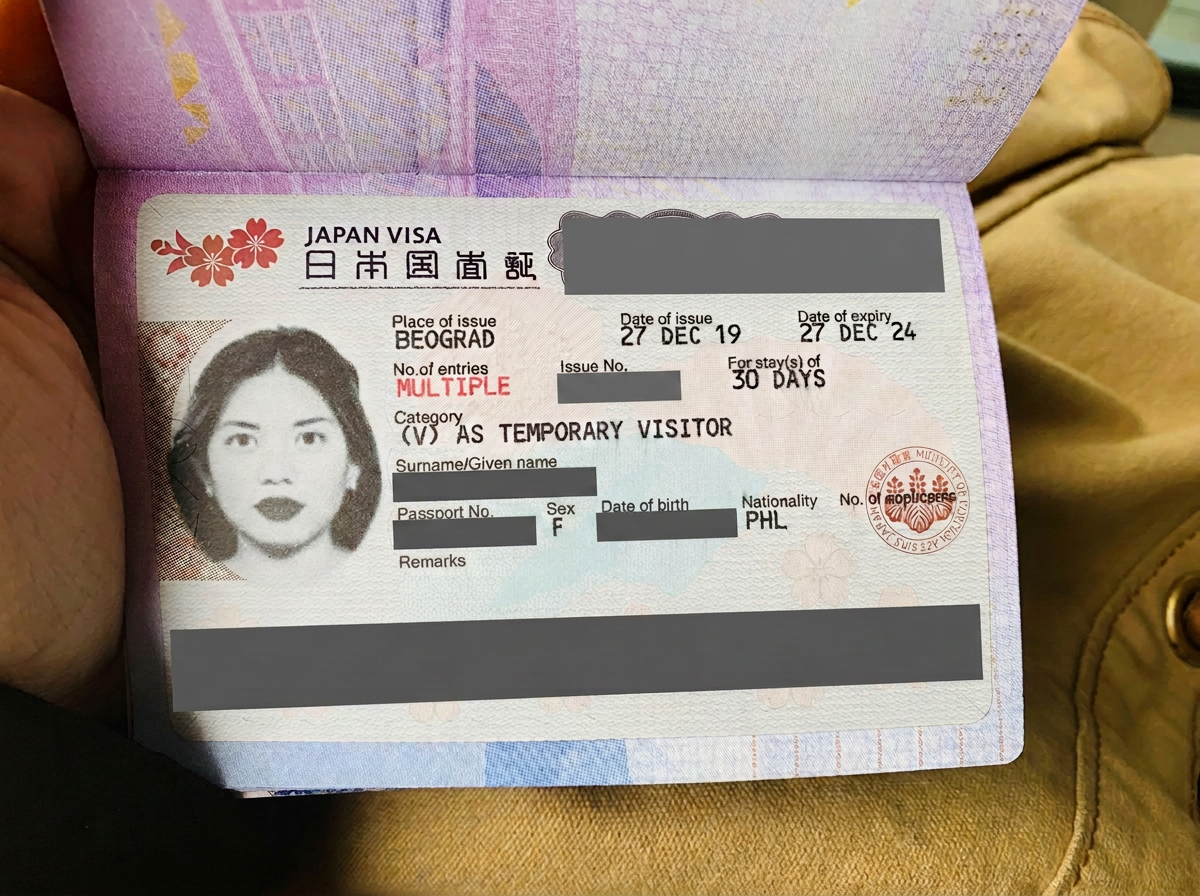
My first Japan Visa - valid for 5 years. I received it from Japan Embassy in Belgrade, Serbia.
The Two Ways to Apply (Pick the Right One First)
This is where most people get confused, so let me make it simple. There are two separate routes, and the one you choose decides everything else: where you file, how much paperwork you submit, and how long you can stay.
Route 1: JVAC (for independent travelers)
If you are planning your own trip, booking your own flights and hotels, and setting your own itinerary, this is your route.
Since April 2025, all independent tourist visa applications go through the Japan Visa Application Centre, or JVAC, which is run by VFS Global. You no longer file directly at the embassy. There are branches in Parañaque, Makati, Quezon City, Cebu, and Davao.
Accredited travel agencies still exist and can help you prepare documents, book your appointment, and hand in your papers on your behalf. But the actual filing now happens through JVAC either way. So if an agency promises a "direct embassy" submission, that is outdated.
Choose this route if you want the freedom to plan your own days, stay longer (up to 90 days per entry), and build the kind of independent travel record that helps your future applications.
Route 2: eVisa (for package-tour travelers)
Japan opened an online eVisa to Filipinos, but with one firm condition: it is only for travelers joining a package tour organized by a travel agency that Japan has designated. You apply fully online, with no JVAC appointment.
To qualify for the eVisa route, you must:
Hold an ordinary Philippine passport
Reside in the Philippines
Travel purely for tourism
Book a package tour run by a Japan-designated travel agency
The trade-off is real, in both directions. The eVisa cuts the heaviest paperwork, so you are no longer required to submit a bank certificate, bank statement, or income tax return. That is a big relief for anyone whose finances are healthy but whose paperwork is messy. The catch is that you give up flexibility. You travel on the tour's schedule, and the stay is short, usually up to 15 days.
Choose this route if you would rather skip the appointment and the bank documents, and you do not mind a fixed group itinerary.
Japan Tourist Visa Requirements for Filipinos (JVAC Route)
Here is the core document checklist for the standard independent application. Treat this as your starting list and confirm the current version on the JVAC or embassy site, since they update it.
Philippine passport, signed, valid for the length of your stay, with at least two blank pages
Visa application form, filled out completely and honestly
One recent photo, 4.5cm x 4.5cm, white background, taken within the last six months
PSA-issued birth certificate (and marriage certificate if applicable)
Daily itinerary for your whole trip, day by day, in the format Japan asks for
Proof of funds: a bank certificate, plus your income tax return or BIR Form 2316
Proof of ties to the Philippines: certificate of employment, business papers, or school records
Roundtrip flight reservation and hotel bookings covering every night
The eVisa package-tour route trims this list, mainly by dropping the bank documents and ITR. That is the single biggest reason people choose it.
A quick note on money, because it worries everyone: there is no fixed "show money" figure. What matters is that your funds make sense for the trip you have planned. A one-week trip does not need a huge balance. It needs a balance that fits the itinerary, plus clean proof that the money is really yours.
How Much Does the Japan Tourist Visa Cost for Filipinos?
The visa itself is free. Japan does not charge Philippine passport holders a consular fee for a tourist visa.
What you do pay is the VFS Global service fee, reported at roughly ₱500 to ₱800 per application. Optional extras like courier delivery or SMS tracking cost a little more and are not required. Japan has signaled that fees are under review, so check the current amount on the VFS page before you go.
If you use the eVisa route through a designated agency, the cost is folded into your tour package instead.
How Long Does It Take, and When Should I Apply?
Official processing is usually about five working days once your complete application is submitted. That sounds fast, and it is. The real bottleneck is getting a JVAC appointment, because slots fill up during peak seasons like spring and autumn.
So the timeline that actually keeps you calm looks like this:
Book your JVAC appointment 2 to 3 months before your trip
Apply within 3 months of your travel date, not earlier
Remember that a single-entry visa is valid for 90 days from the date it is issued, so applying too early can backfire.
If you have visited Japan before, or you have travel history in G7 countries, and your finances are solid, apply for a multiple-entry visa. It costs the same and saves you from repeating this whole process next time.
Make It a Trip: What to Do Once You Land
Since you are already going, plan the trip around something you love. Japan runs on seasons, and each one gives you a different country: cherry blossoms in spring, cool hikes and festivals in summer, red maples in autumn, snow and onsen in winter.
If you follow tennis, autumn is a bonus. Japan hosts two WTA tour events back to back, the Japan Open in Osaka and the Toray Pan Pacific Open in Tokyo, usually in October. One visa, two cities, world-class sport. It is a smart reason to time your trip, and a fun one if you are cheering for our own Alex Eala.
A few things I set up before every Japan trip so the small stuff never trips me up:
An eSIM so I have data the second I land. I use Airalo (code KATRIN8414 for a discount). No airport SIM lines, no roaming shock.
Travel insurance, because Japan is safe but medical care is not cheap for visitors. I use SafetyWing
Luggage storage for those in-between hours after checkout. Bounce is everywhere in Tokyo and Osaka (code KACH).
Tickets and day tours booked ahead through GetYourGuide, so the popular ones do not sell out from under me.
Common Reasons Filipinos Get Denied (and How to Avoid Them)
Most denials are not about the passport. They are about the paperwork telling a story that does not add up. Watch for these:
Money that does not match the trip. A sudden large deposit right before you apply looks staged. Keep your funds steady and real.
A vague itinerary. Japan wants to see that you have actually thought through your days. Fill it in properly.
Weak ties to home. Your job, business, or school record is what says you will come back. Do not skip it.
Rushing. An incomplete form or a missing PSA document sends you to the back of the line.
Get these right and you have handled the parts that actually decide the outcome.
Frequently Asked Questions
Can Filipinos enter Japan without a visa? No. Philippine passport holders always need a tourist visa issued before travel. There is no visa-free or visa-on-arrival option.
Can I apply for the Japan visa online? Only if you are joining a package tour run by a Japan-designated travel agency. Independent travelers apply through JVAC (VFS Global) in person.
Is the Japan tourist visa really free? Yes, the visa has no consular fee for Filipinos. You only pay the VFS service fee, roughly ₱500 to ₱800, unless you go the package-tour eVisa route, where it is part of the package price.
How much show money do I need for a Japan visa? There is no official fixed amount. Your funds should reasonably cover your planned trip, backed by a bank certificate and your ITR. A modest, well-documented balance beats a large but unexplained one.
Can I apply for a Japan visa in another country? Apply in your country of citizenship or legal residency. If you live and work in the Philippines, you apply here.
How early can I apply? Within 3 months of your trip. A single-entry visa is valid for 90 days from issue, so do not apply too far ahead.
Ready to Go? Let FilipinoPassport.com Take the Paperwork Off Your Plate
Getting into Japan is very doable on a maroon passport. It just rewards preparation. If you would rather have someone handle the document prep, the appointment, and the checklist so nothing gets bounced, that is exactly what my visa services team does for Filipino travelers every week.
Japan is one step. Once your passport carries a few of these, the bigger doors open faster. That is the cascade. Let's get you moving up it.
Kach Umandap is the Youngest Filipina to visit all 195 countries, and the First Filipino to do it solely on a Philippine passport. She writes about visa-smart travel for Filipinos at travelwithkach.com. This guide is for general information and reflects the rules as of September 2026. Visa policies change, so always verify current requirements with the Embassy of Japan in the Philippines before applying.
