
The Philippine Passport Cascade Hack: How I Travel the World Without a Second Citizenship
People assume that to see the whole world, a Filipino needs a second passport. A European grandparent. An investor visa. A lucky marriage. Some door the rest of us were not born standing in front of.
I am living proof that this is not true.
I visited all 195 countries solely on a Philippine passport, finishing in Sudan on January 6, 2025. No second citizenship. No shortcut nobody else could take. What I had instead was a method - one I built over twelve years of standing in immigration lines, being underestimated, and slowly learning the pattern underneath it all. I call it the Philippine Passport Cascade Hack™, and it is the single most useful thing I know how to teach.
This is the full version of that method. Let me walk you through it the way I actually lived it.
First, the honest part
I am not going to sell you a fantasy. Our Philippine passport ranks low on paper, and traveling with it was genuinely hard for me in the beginning. I am also not going to pretend the Cascade Hack applies to everyone equally. Some Filipinos get a US visa because of a powerful job, a large business, or a kind of privilege that already opens doors. That is real, but it is the exemption, not the rule - and this method is written for the rest of us, the ordinary traveler starting from zero.
One more boundary before we begin: everything here is about tourism visas. Not work, not study, not investor pathways. Those follow completely different rules. What I am teaching is the ordinary tourist track that any Filipino can aim for.
The clue that changed everything
My whole framework rests on a single realization: immigration reads your history before it reads your bank account. And here is the modern update - these days it barely matters whether you collect a physical stamp or an e-visa. So much of travel is digital now that the ink is beside the point. Stamped or not, your travel history is your resume, and it follows you into every application.
You can see this written plainly into European law. Under the EU Visa Code, the Schengen visa rewards your record in stages. You start with a single entry. You use it well and come home on time, and next time you can earn a multiple-entry visa, then one good for up to a year, then two years, and eventually up to five - each tier unlocked by the one before it. Europe literally legislated that a clean travel record earns you longer access.
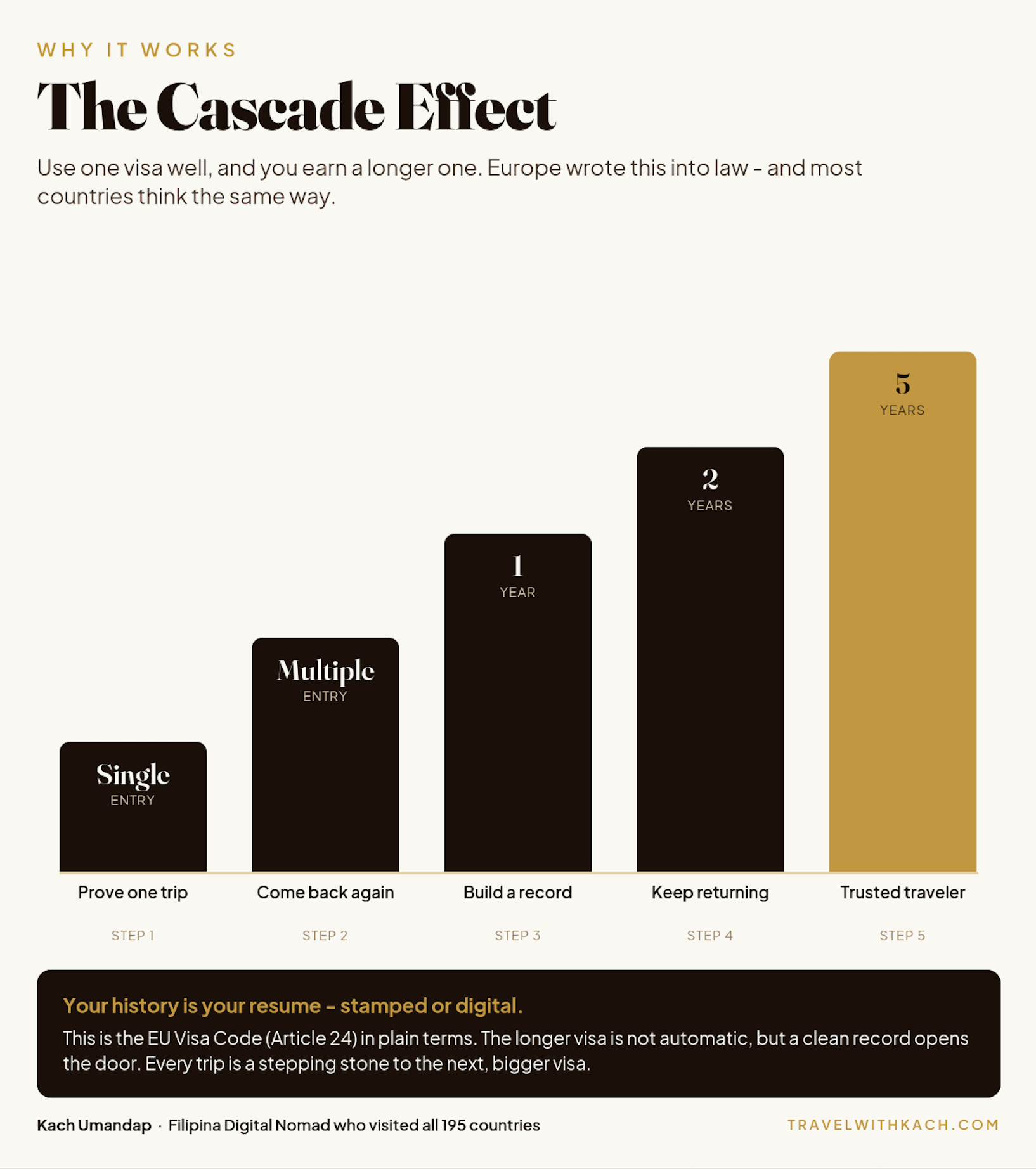
Once I saw that logic spelled out in one place, I started noticing it everywhere. Most countries think the same way, even when they never publish a rulebook. That staircase is the "cascade," and learning to climb it on purpose is the whole game.
Where it began: Bogota, 2015
My map opened up slowly. I started with the countries closest to home - the visa-free ones - because when you have barely traveled, it is smart to stay one or two hours away, somewhere easy to return from. From ASEAN I moved out to South America, collecting stamps as I went.
The real turning point came in 2015, when I was living my digital nomad life in Bogota, Colombia, and I was approved for my US visa for the very first time. That one approval changed everything that came after it. I want to be transparent, though: I got that visa by applying as a visitor in a third country, and in 2026 that route has essentially closed. Consulates now expect you to apply from your country of residence or citizenshup. So do not copy my exact shortcut - copy the principle underneath it.
The ladder, step by step
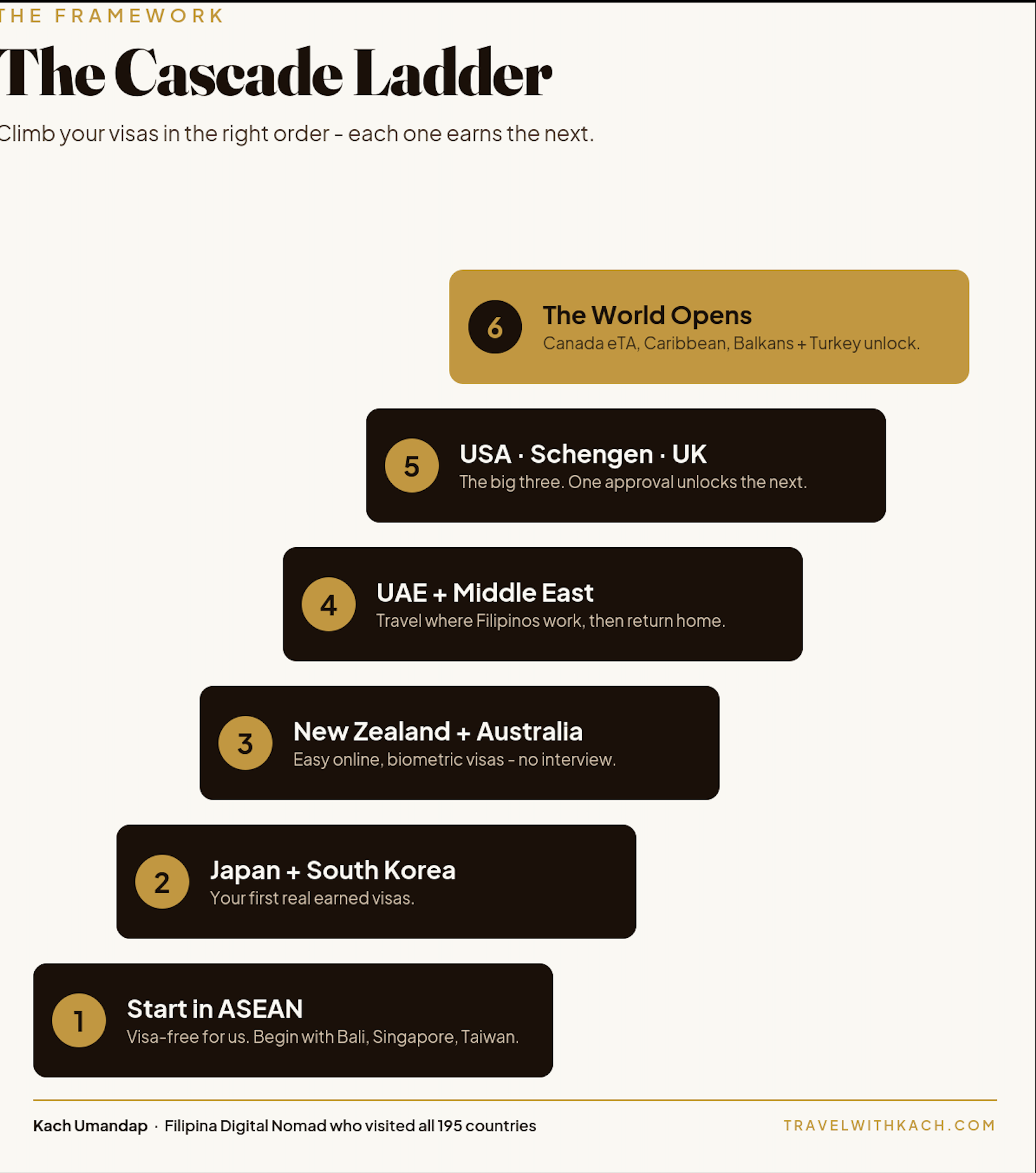
Here is the order I recommend, and the order that I recommend for you.
Start in ASEAN, but choose wisely. All of ASEAN is visa-free for Filipinos, so begin there. But pick destinations that do not have a huge Filipino worker population, because those are the least likely to question your intentions. Bali and Singapore are perfect for a first short trip. Taiwan is another excellent choice and, as of now, still visa-free for us. Thailand, Laos, and Vietnam are wonderful too - Vietnam especially - but so many Filipinos work there now that it can invite extra scrutiny at the start.
Earn Japan, China and South Korea. These are your first real "earned" visas, and they carry weight for everything that follows.
Collect the online visas. New Zealand and Australia are largely biometrics and paperwork rather than a full interview. They grow your record with far less stress.
Go where Filipinos work, then come home. Visit the UAE and the wider Middle East. This step is quietly powerful. When our immigration officers and embassies see that you can travel to a place full of work opportunities and still return home, on time, for vacation, they stop reading you as a flight risk. You become a traveler, not a worry.
Reach for the big three. Only now do you apply for the US, Schengen, and UK visas. The US tourist visa for Filipinos is usually granted for ten years. Canada's visitor visa can run up to ten years too, and once you hold a valid US visa, Canada's eTA becomes easy. The UK is its own ladder - six months, then two years, five, even ten, depending on how consistently you return. One approval keeps unlocking the next.
The second pillar nobody talks about: residency
Here is the piece most travelers miss entirely. Having a Philippine passport is great, but pairing it with a residency abroad makes your movement dramatically easier.
Think about this. There are only around sixty to seventy foreign embassies in the entire Philippines. That sounds like a lot until you realize how many countries have no mission here at all. For those visas, we are forced to apply abroad - in China, Japan, Indonesia, Malaysia, Singapore, or Thailand. That is expensive, slow, and exhausting.
A few years ago I got my UAE residency and I now have a Golden visa as a Content creator, and it solved this completely. From Dubai, I could finally apply for countries across Africa and the Pacific Islands that simply have no embassy in Manila. Whole regions of my map became reachable overnight.
So before you jump to the idea of a second citizenship, ask yourself: why not hold your Philippine passport, build your visa stack, and add a residency in a country? That combination gives you most of the freedom people chase citizenship for, without the heavier tax and residency obligations.
What the stack actually does at the counter
I will be honest about how these applications feel. In many countries, the officer looked at me and clearly wondered why a Filipino was standing there, and often assumed I had come looking for work. But the moment they saw my travel history and my valid US, Schengen, and UK visas, everything shifted.
We do not have to call it racism to name the reality: in countries that are hard to enter, and that have few ties with the Philippines, the officers know their own citizens struggle to get those exact same visas. So when they see them already in your passport, it reassures them. It answers their biggest question before they ask it. Getting African visas is genuinely hard, but the people who manage it almost always have a strong multi-country stack behind them.
One clean money trail
A single habit made all of this smoother. I keep one bank account that I feed regularly, on purpose, so the money is clearly there and has been there for at least the past six months. I call it my travel fund, my visa-application fund. I use it, I replenish it, I keep it clean.
Please do not hand an embassy ten different bank statements. It only confuses them. Picture how many applications an officer reviews, often by hand, with no time to spare. You want your file to be simple and consistent, not a puzzle to solve.
The payoff: visas that unlock more visas
Here is the reward that makes every hard application worth it. Once I had my US visa, a whole set of countries quietly became visa-free for me.
Did you know you can travel much of the Caribbean visa-free by cruise? I traveled from Mexico down to Panama without a single extra visa, purely because of my US visa. I traveled the Balkans in Europe on the strength of it. I got my Turkey e-visa because of it. These hard-won visas keep paying you back, and most stay valid for ten years, or until your passport expires. You do the difficult work once, and it opens door after door for a decade.
My current stack
So you know this is not theory, here is what I hold right now: a valid ten-year US visa, a valid ten-year UK visa, a valid two-year Schengen visa, and a valid ten-year Canada visa. For Australia and the others that are done online, I simply apply when I actually need to go.
None of it came at once. It came in order, one stamp earning the next. That is the entire secret.
The mindset to carry
If you remember nothing else, remember this: every time you travel, treat that trip as a stepping stone to the next, bigger visa. Your passport is not just a document you own. It is a record you are building on purpose.
I did not start with a strong passport. I started with a plan. The Philippine Passport Cascade Hack is that plan - and it is available to any Filipino willing to climb the staircase one honest step at a time.
Follow my journey and learn the full system at travelwithkach.com and on Instagram @kach.umandap and @2monkeystravel.
