
How to Travel the World for Free as a Volunteer English Teacher - Tips for Filipinos
Here is something most Filipinos never realize: the skill that can carry you around the world for almost nothing is one you already have. It is English.
We grow up speaking it. It is one of our official languages. And all over the world - in countries where English is not the first language - there are families, schools, hostels, and language programs willing to give you a free bed and free meals just to practice with someone fluent. I know this works because it is exactly how I funded my early years on the road. Long before I finished all 195 countries, I was teaching English in Hanoi to pay for the next leg of my trip.
So let me show you how to do it - honestly, safely, and without falling for the traps.
First, the honest truth about "free" volunteering
Let me clear up the biggest confusion right away, because this is where people get scammed.
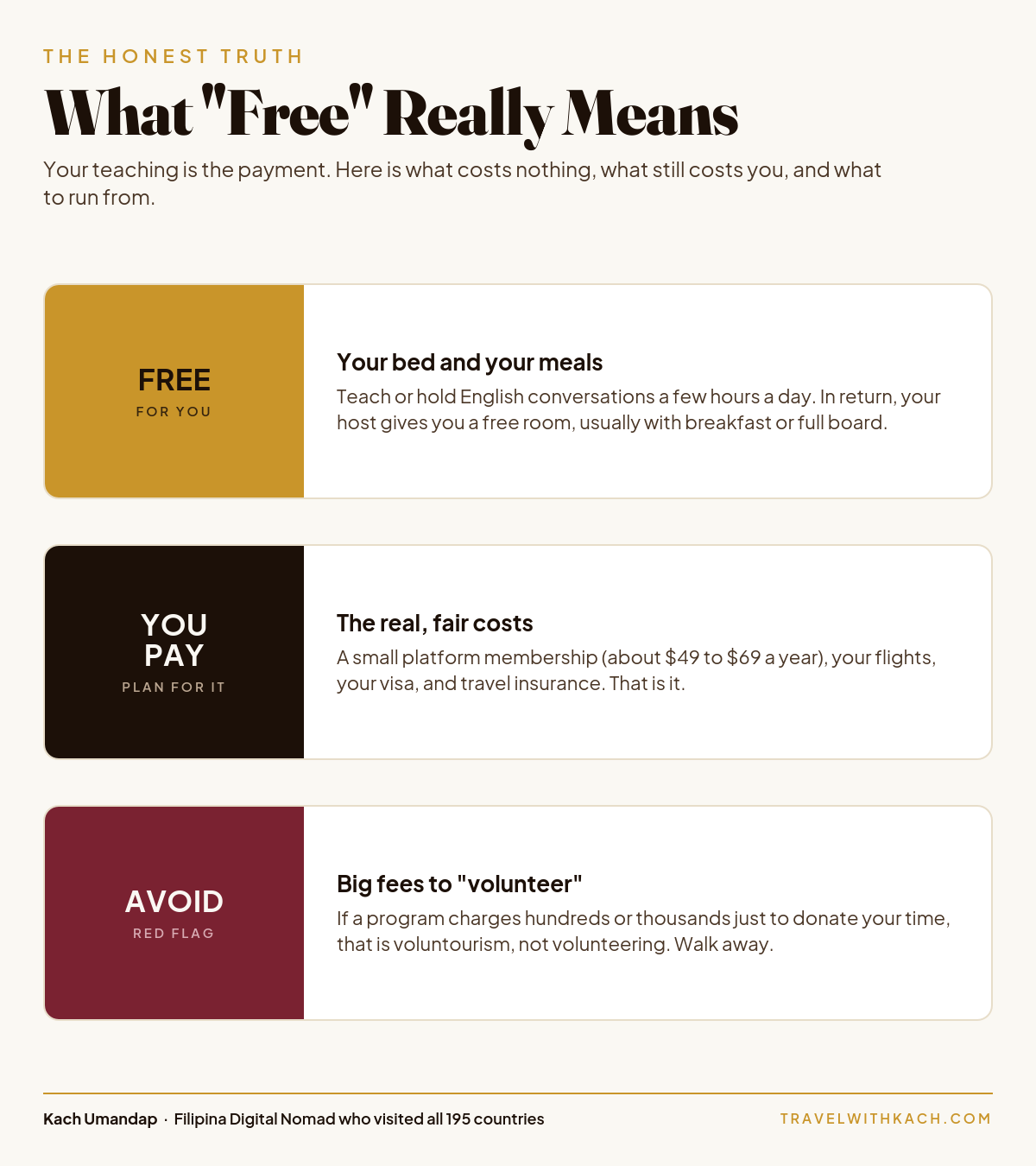
You should never pay a large fee simply to donate your own time and skills. If a program asks you for hundreds or even thousands of dollars to "volunteer," that is not volunteering - that is voluntourism, and it is often a business dressed up as a good deed. Walk away.
Here is what "free" actually means in a genuine exchange. You teach or hold English conversations for a few hours a day. In return, your host gives you a free bed, and usually breakfast or full meals too. That is the deal. Your labor is the payment.
But be clear-eyed about what you still have to cover yourself:
A small platform membership. The trusted websites that connect you with safe, verified hosts charge a modest yearly fee - think of it as paying for the safety and the matchmaking, not for the volunteering itself. This is normal and worth it.
Your flights, visa, and travel insurance. These are always on you.
Getting to the location once you land.
So "free" is not zero pesos. But it can turn a trip that would have cost you a fortune in hotels and food into one where your biggest expense is the plane ticket. That is the hack.
The one exception to the "never pay a fee" rule: some legitimate non-profit NGOs and small community schools ask for a small contribution to cover your food and the real cost of hosting you. That can be fair. The red flag is the size of the fee and where the money goes - a few dollars a day for your own meals is reasonable, a four-figure "program fee" is not.
Your Filipino advantage - and how to make it stronger
In this world, your fluency is your passport. Many volunteer and immersion programs do not ask what country you are from - they ask what level of English you speak. If you are a confident C1 or C2 speaker, which countless Filipinos are, you qualify. When you apply, lead with your fluency and your warmth, not with an apology. You belong in these rooms.
Now, if you want to open even more doors - and eventually turn this into real income - get TEFL certified. TEFL stands for Teaching English as a Foreign Language, and it is the certificate that schools and better-paying hosts look for. It teaches you how to actually run a lesson, not just chat, and it is the single best upgrade you can make to your teaching profile. Many volunteer hosts prefer certified teachers, and once you have it, you can move from free stays to paid teaching jobs anywhere in the world.
This is the one thing I always tell aspiring nomads to invest in first. I partnered with myTEFL because their online course is affordable and self-paced, and you can use my code KACH50 for 50% off. You can get certified here: myTEFL with code KACH50.
Where to go - the best countries for Filipino volunteers
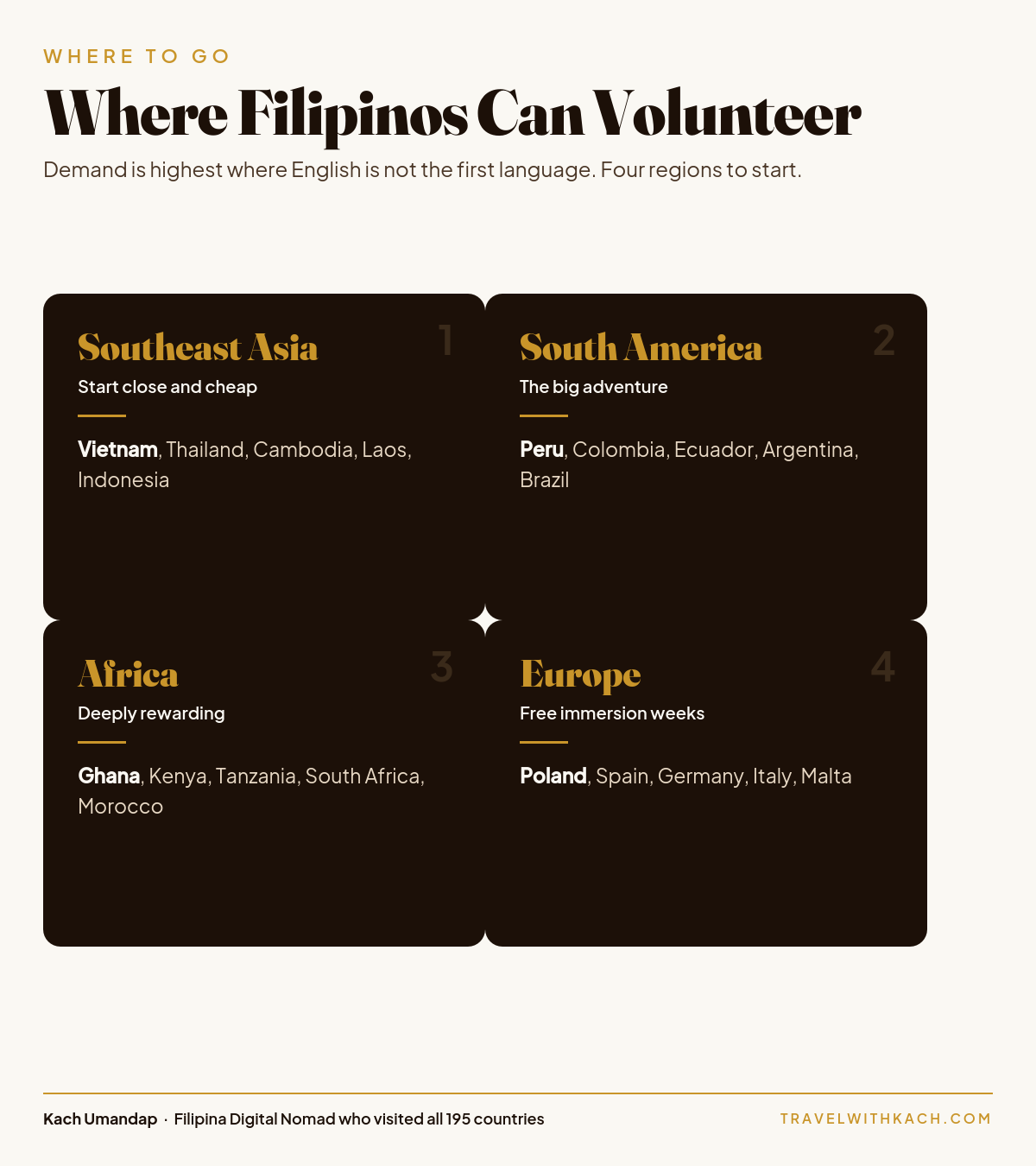
The demand is highest where English is not the first language. Here is where I would point you, region by region.
Southeast Asia (start here - it is close and cheap)
If you have not traveled much yet, begin near home. Vietnam has enormous demand for English practice, a low cost of living, and it is a short, affordable flight from Manila. Cambodia, Laos, Thailand, and Indonesia are all wonderful too, with hostels and community projects that regularly host English-speaking volunteers. You get to build your confidence in a region that feels familiar before going further afield. Just make sure to check the visa rules for Filipinos.
South America (the great adventure)
This continent changed my life, and it is full of opportunity. Peru, Colombia, Ecuador, Argentina, and Brazil all have community schools, hostels, and family homestays hungry for English conversation. The culture is warm, the landscapes are unreal, and a little Spanish will take you a long way. Many volunteers here trade a few hours of teaching for a bed in a hostel and end up staying for months.
Africa (deeply rewarding)
For something truly meaningful, look at Ghana, Kenya, Tanzania, South Africa, and Morocco. English teaching volunteers are genuinely needed, especially in community schools. Africa asks a little more planning - visas, vaccinations, and careful host vetting - but the experience is unforgettable. Do your homework here and go through trusted platforms only.
Europe (the clever bonus most Filipinos miss)
Here is a secret. There are English immersion programs in Europe that will house and feed you in a beautiful hotel for a week, for free, in exchange for simply having English conversations with local professionals. No formal teaching required - just chatting. Programs like Angloville (Poland, Malta, Italy and more) and Pueblo Inglés / Diverbo (Spain and Germany) run these all year. They typically cover your room and full board; you cover your flights and your way to the meeting point. It is one of the most affordable ways I know to experience Europe, and Angloville even offers a TEFL scholarship option while you are there.
Where to find the opportunities - the websites to bookmark
These are the platforms I would actually trust. Remember the hack: you pay the platform's yearly membership for safe, verified hosts, but the volunteering itself should never cost you a placement fee.
Workaway - the biggest work-exchange network, with hosts in over 165 countries. The membership runs around 69 US dollars a year for a solo traveler. Great for homestays and teaching exchanges.
Worldpackers - similar idea, membership around 49 US dollars a year, hosts in 140-plus countries. More than 80 percent of their hosts charge no extra fee, and they have solid safety support for first-timers.
Angloville - for the free European immersion weeks described above, with an optional TEFL qualification.
Pueblo Inglés / Diverbo - free week-long English "villages" in Spain and Germany, room and full board included.
HelpX - another long-running work-exchange site worth checking.
Volunteer World, GoOverseas, and GoAbroad - useful for browsing and reading real reviews, but read carefully here, as many listings are paid voluntourism. Use them for research, then verify.
Beyond the platforms, do not underestimate going direct. Local NGOs, small schools, monasteries, and community centers often welcome volunteers, and Facebook groups for expats and backpackers in your target country are goldmines for word-of-mouth placements.
Stay safe - especially if you are a solo Filipina
Freedom is only worth it if you come home safe. These are non-negotiable for me.
Vet every host. Only choose hosts with verified badges and plenty of genuine reviews. Always do a video call before you commit - you learn more in ten minutes on camera than in fifty messages.
Check the visa rules honestly. Many people volunteer on a tourist entry, but the rules vary by country and some technically require a specific visa. Confirm before you fly rather than risk trouble at immigration.
Get travel insurance. I never travel without it. SafetyWing is built for nomads and covers you long-term across borders.
Stay connected. Land with a working eSIM so you can call for help the moment you arrive - I use Airalo with code KATRIN8414. Share your full itinerary and your host's details with your family, and save the number of the nearest Philippine embassy.
Keep an emergency fund and a way out. Always have enough savings for a hotel and a flight home, and never let anyone hold your passport.
Trust your gut. If a place feels wrong, you are allowed to leave. No free bed is worth your safety.
Turn "free" into a career
Here is the part that excites me most. Volunteering is not just a way to travel cheaply - it is the on-ramp to a location-independent income. Every stay builds your experience and your references. Add your TEFL certificate, and you can move from free room-and-board into paid teaching, both in classrooms abroad and online from anywhere. My own English teaching in Hanoi started at around 17 US dollars an hour, and that income is what bought me the freedom to keep going.
That is the real destination. Free volunteering gets you out the door and into the world. A teaching skill and a certificate keep you out there on your own terms. This is exactly how an ordinary Filipino becomes a digital nomad - one lesson, one country, one stamp at a time.
Your English is already a kind of passport. All that is left is to use it.
A note on the links: some of the resources above are affiliate links, and my myTEFL code KACH50 gives you 50 percent off. Using them costs you nothing extra and helps support this blog - thank you.
Follow my journey at travelwithkach.com and on Instagram @kach.umandap and @2monkeystravel.
